

HR teams are tasked with maintaining benefits that are competitive in the market without letting healthcare costs run unchecked. But choosing the right benefits is only part of that job. Once those benefits are in place, HR also has to help employees understand how those choices translate into healthcare costs and coverage for their particular household. And with health insurance, that gets complicated fast, because the right answer can look very different from one family to the next.
HR knows the plans and benefits the company offers, but they generally don't have the same visibility into the rest of an employee's household. They don't know the details of a spouse's health plan, what it costs, how a family might divide coverage, or what healthcare needs that family is trying to plan for in the coming year. There isn't one explanation that works for everyone.
In a way, employees and their families are searching for Schrödinger's cat: the health plan that is both the cheapest and the best fit for their family, depending on everything that might happen over the next year. They can look at premiums and deductibles, compare plan documents, and try to estimate their healthcare needs, but until they put all of those variables together, they don't really know which option makes the most sense.
The Total Care Option (TCO) adds another layer to an already personal decision. An employee might be comparing several plans through their employer with a number of options available through a spouse, figuring out which members of the family should be on which plan, and trying to understand how premiums and out-of-pocket costs could add up throughout the year. With so many variables, the number of possible combinations can grow quickly, and the right choice isn't the same for every household. It depends on the people covered, the plans available to them, and what they can reasonably expect their healthcare needs to look like in the coming year.
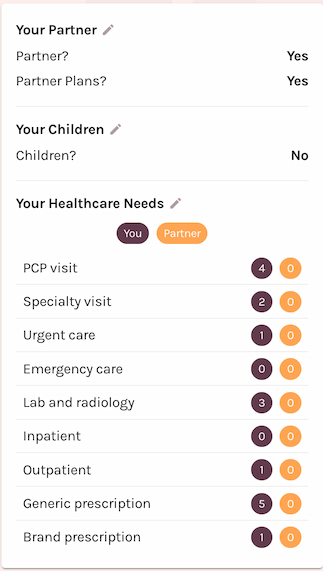
The Decision Support Tool (DST) brings those variables together so employees can evaluate their coverage as a household, rather than comparing pieces of each plan separately, and turns all of it into a side-by-side view of the available options with the estimated cost of each one clearly laid out.
Inside the comparison
Employees can upload their spouse's benefit guide, and the tool extracts the relevant plan information to build that side-by-side comparison automatically. Employees without another plan to compare can still use it to evaluate the options available through their own employer.
.jpg)
Getting to that simple result is the fun part. Health insurance is an incredibly complex system, which makes it an interesting problem to build for: how do you account for all of that complexity without passing it on to the person trying to make a decision?
A family might have several plans available through one employer and a different set through a spouse's employer. They may be able to put everyone on one plan, split the family between plans, or make other combinations depending on how the benefits are structured. Then there are premiums, deductibles, copays, coinsurance, prescriptions, and accounts like HSAs, FSAs, and HRAs to account for. The employee doesn't need to understand all of those variables individually. They need to be able to see how they come together.
Most benefits tools are good at explaining what a plan is. A useful Decision Support Tool needs to help someone understand what that plan means for them.
What makes health plan decisions so complicated
On the surface, comparing two health plans sounds like a relatively simple exercise. Look at the premium, look at the deductible, look at the out-of-pocket maximum, and pick the one that looks like the better financial choice. A household rarely makes the decision that way.
Every household is effectively choosing its own risk profile. One family may be comfortable paying less each month and taking on more costs if something unexpected happens. Another may pay more upfront because they value knowing their costs will be predictable.
This is where the Decision Support Tool becomes useful to an employer. HR can explain the plans. What HR generally can't do is sit down with every employee, learn about their household, gather their spouse's benefit information, run all of the possible combinations, and explain the financial tradeoffs.
Software can run through those variables the same way for every household. Healthcare is personal, but personalized doesn't have to mean handmade. It just means the numbers are theirs.
How we get to an accurate number
The hardest part of building a Decision Support Tool for health insurance isn't putting a calculator on a webpage. It's representing the underlying system accurately enough that the answer is useful.
Health insurance is full of rules and variables that interact with one another. If we're going to tell an employee that one option is likely to cost their family less than another, we first need to make sure we understand what those plans actually cover and how they work. That's why the DST combines technology with human review.
When an employee uploads a spouse's benefit documents, our AI analyzes the plan information and extracts the details needed for the comparison. Our operations team then reviews the results. On average, that review takes 4-6 business hours. Once it's complete, the employee receives an email and can review the comparison and recommendations directly in the app. AI is useful here, but it isn't making the healthcare decision.
It's doing something computers are particularly good at: taking a large amount of unstructured information and turning it into structured data that the rest of the system can work with. That used to require considerably more manual data entry. Automating that part means we can process plans faster while still having people review the result.
Depending on the plans available and the way a household can structure its coverage, there can be a surprisingly large number of possible combinations. We don't want to guess at which one is probably best and stop there. We calculate the cost across all of them and compare. When the answer affects someone's healthcare costs, we'd rather do the computation than ask an algorithm to make an educated guess.
Why this matters to an employer
We think about Healia as a technology company that happens to work in healthcare.
Healthcare is the problem we're working on. But many of the hardest problems inside healthcare are problems of information and scale. There is an enormous amount of information contained in benefit documents, plan designs, family circumstances, and healthcare decisions. Making that information useful to one person is relatively easy when a benefits expert has an hour to sit down with them. Making it available to thousands of employees is a very different problem. Technology is what makes the second version possible.
The Decision Support Tool takes work that would traditionally happen between an employee and a benefits expert and moves much of it into software. It can collect plan information, process documents, run the comparisons, and give employees a place to explore the results. The human component moved to the places where review and judgment matter most, not away.
For an HR team, that distinction matters. The goal isn't to replace HR's role in benefits education. It's to give employees somewhere to go when their question becomes personal.
An employee doesn't usually ask, "Can you explain the difference between these two deductibles?" They ask, "Which one makes more sense for my family?" Those are very different questions.
The employee experience is part of the benefit
This becomes especially important when an employer introduces a benefit like the Total Care Option.
The employer can explain what the TCO is, how it works, and why it exists. But eventually an employee is going to ask the question that only they can really answer: does this make sense for my family?
The Decision Support Tool gives them a way to work through that question. They can compare their employer's plans with their spouse's plan, see how the different coverage arrangements stack up, and understand the financial implications before deciding what to do. The tool isn't intended to push every employee toward the TCO. It can just as easily show an employee that staying on their employer's plan makes more sense.
Good decision support shouldn't be a sales funnel disguised as a calculator. If we're asking employees to trust the tool, the answer has to be objective. For employers, that creates a better benefits experience too: employees get more information before they make an important decision, and HR doesn't have to personally provide the same individualized analysis to every household.
Not just another benefits platform
There are plenty of benefits technologies that make enrollment easier. That's useful, but it's a different problem. We're interested in what happens after an employee is presented with their choices.
A benefits guide can tell someone what a plan covers. A carrier website can explain its network. An enrollment platform can collect an election. None of those things necessarily answer the question an employee actually has when they're trying to choose: which option makes the most sense for me?
It requires healthcare expertise, but healthcare expertise alone isn't enough. It requires the ability to ingest information from plans that weren't designed to be compared with one another, turn that information into something structured, run calculations across a potentially large number of scenarios, and present the result in a way that a normal person can understand.
We can solve this because we sit at an intersection that's hard to find in healthcare: a technology team capable of building software like this at scale, and deep relationships with brokers and health insurance industry knowledge. Most companies are strong on technology or strong on healthcare. Rarely both.
What this means for HR
Any new benefit creates work for HR. That's true even when the benefit is a good one, because employees don't experience benefits as abstract plan designs. They experience them through their own families, their own healthcare needs, and their own finances. Individualized questions are inevitable.
The Decision Support Tool doesn't eliminate those questions, and it shouldn't. There will always be employees who want to talk to a person or need help understanding something unusual about their situation. What it does is give employees a useful first place to go, so HR doesn't have to be that first place for every employee.
That difference becomes meaningful during open enrollment, when the same few weeks can generate hundreds or thousands of questions. Instead of asking an HR team to scale individualized guidance by adding more conversations, the technology gives employees a way to work through many of those decisions themselves.
Why we built the Decision Support Tool
Our team believes healthcare should be simpler, but that doesn't mean acting as if the underlying system is simple. It means building technology that can absorb more of that complexity itself, so less of it lands on the person trying to make a decision.
That's how we think about the Decision Support Tool. An employee sees a relatively straightforward comparison, but behind it, technology is processing plan documents, structuring the information, evaluating the available options, and routing the results through human review where it matters. That combination is what lets us deliver something that's normally hard to offer at scale: individualized guidance for an entire workforce, not just the employees with time to sit down with a benefits expert.
For an employer, that's the real value of building this as software instead of relying on a person to walk every employee through it individually. It's a system that works through the complexity of each employee's situation and helps them understand their own choices.
Interested in learning more?
See what the Decision Support Tool and Total Care Option could mean for your workforce.