

What I hear consistently from HR teams is that when it comes to benefits, no news is good news. HR is already holding a lot, and open enrollment is their Super Bowl. The last thing anyone needs on top of that is a wave of employee concerns about one of the company's providers. With Healia, the news that reaches HR is usually good, and when something does need attention, it typically doesn't reach HR at all. That's not an accident. It's a direct result of how the claims process is built.
Why HR doesn't hear about problems with this benefit
For Healia customers, there's very little for HR to manage day to day. Healia fronts the funds for approved claims and invoices weekly, every Monday for the prior week's activity, with admin fees billed monthly, one month in arrears. An employer dashboard shows every invoice, enrollee status by month, and a full claims breakdown by approved, denied, or pending status, so if anyone wants to check on the benefit, the answer is one click away rather than a call to an account manager.

The bigger reason HR stays out of it, though, is that employees rarely need to escalate anything. If a question comes up, it goes to Healia's support team directly, and our average ticket response time this year has been 2.5 business hours. A question raised in the morning is typically answered the same day. HR teams already running lean don't need another source of employee friction, and this benefit is designed specifically not to create one.
Inside the claims process
The reason employees rarely need to escalate is that the process itself is built to be forgiving rather than adversarial.
Submitting a claim is a one step process. On a phone, an employee taps Submit New Claim and photographs an itemized bill, an EOB, or a pharmacy slip. On a laptop, they upload a PDF. That's the entire task. No categorizing the expense, no entering a service date. Healia's team extracts that from the documents directly.
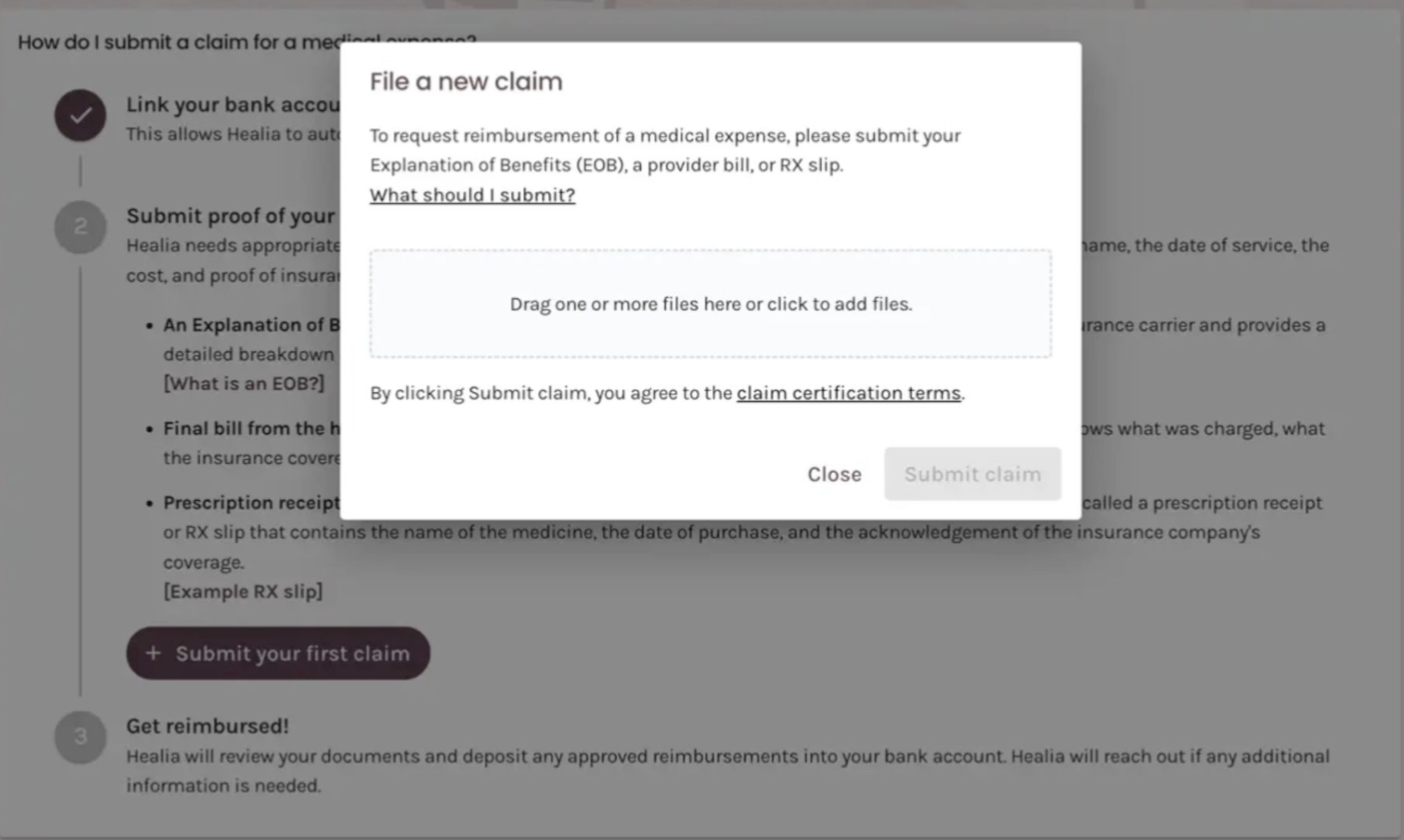
Most Third Party Administrators (TPAs) and claims adjudicators default to denying a claim when documentation is incomplete, then leave the employee to resubmit or go to their HR team to get their questions answered. Healia holds an unclear claim in an intermediary status instead (needs more information), neither approved nor denied, and tells the employee exactly what's still needed. Nothing gets rejected outright. There's no financial incentive on our end to deny a claim that falls within the plan's design, so approving it is simply the benefit doing what it's supposed to do.
Any deductible, copay, or coinsurance expense incurred through the spouse's insurance can be reimbursed. Explanation of Benefits (EOBs) are the gold standard, since carriers issue them finalized and itemized. Pharmacy slips need more scrutiny, since the receipt has to show that insurance was actually applied, but the underlying question never changes: did the spouse's plan approve this, and what does the member owe.
Duplicate detection runs on every submission, so an employee unsure whether they already filed a document can just submit it again. If it matches something already reimbursed, they're told which claim. If it doesn't, they're simply paid.
For plans with premium reimbursement, an employee uploads one paystub showing their medical insurance deduction, and every subsequent month's reimbursement generates automatically at the plan's cap until a life event changes it. There's nothing recurring for the employee to manage.
Turnaround holds the same standard regardless of claim size: a two-business-day SLA for review, then two to three business days for Stripe to move the ACH transfer. End to end, that's two to four business days from submission to funds landing, for a $5 copay or a $10,000 hospital bill alike.
What this means for employers
A benefit employees actually find easy to use is a benefit that generates goodwill instead of tickets. That's the return on a claims process built this way: fewer questions redirected to HR, a benefit that reads as a real perk rather than a hassle, and a dashboard that gives finance and HR full visibility without requiring anyone to chase it down.
If you're an employee covered under this plan, the short version is: submit whatever documentation you have, in whatever form you have it, and let Healia determine if it qualifies. If something's missing, you'll hear exactly what's needed. Once approved, expect the money within two to four business days.
This claims process only matters once a benefit like the spousal HRA is in place. If you want to see how the Total Care Option actually works, from eligibility to the savings employers see, read our full breakdown of the benefit here.
Frequently asked questions
How does an employee submit a claim?
On a phone, they tap Submit New Claim and photograph an itemized bill, an EOB, or a pharmacy slip. On a laptop, they upload a PDF. That's the entire task. Healia's team extracts the service date, expense type, and amount directly from the documents, so the employee doesn't have to categorize anything themselves.
What expenses actually qualify for reimbursement?
Any deductible, copay, or coinsurance expense incurred through the spouse's insurance can be reimbursed. EOBs are the gold standard, since carriers issue them finalized and itemized. Pharmacy slips need more scrutiny, since the receipt has to show that insurance was actually applied. The underlying question is always the same: did the spouse's plan approve this, and what does the member owe.
What happens if documentation is incomplete?
Healia holds the claim in an intermediary status, neither approved nor denied, and tells the employee exactly what's still needed. Nothing gets rejected outright. Since there's no financial incentive to deny a claim that falls within the plan's design, approving it once the documentation is complete is simply the benefit doing what it's supposed to do.
What would cause a claim to actually be denied?
Three things: the expense occurred before the employee's enrollment date, the expense type isn't covered under the plan design (vision, for example, when the plan doesn't include it), or the receipt shows no insurance adjustment, meaning it wasn't run through the spouse's plan at all.
What if an employee already submitted a document and isn't sure?
They should submit it again. Duplicate detection checks every submission against prior claims. If it matches something already reimbursed, they're told which claim. If it doesn't match, they're simply paid.
How does premium reimbursement work?
For plans that include it, the employee uploads one paystub showing their medical insurance deduction. Every subsequent month's reimbursement generates automatically at the plan's cap until a qualifying life event, like a new dependent or coverage tier change, requires an updated paystub. There's nothing recurring for the employee to manage in between.
How fast do employees actually get reimbursed?
Claims carry a two-business-day SLA for review. Once approved, Stripe processes the ACH transfer in two to three business days. End to end, that's two to four business days from submission to funds landing, whether the claim is a $5 copay or a $10,000 hospital bill.
What does an employer actually see or manage day to day?
Very little. Healia fronts the funds for approved claims and invoices weekly, every Monday for the prior week's activity, with admin fees billed monthly, one month in arrears. An employer dashboard shows every invoice, enrollee status by month, and a full claims breakdown by approved, denied, or pending status, so the answer to "how's the benefit doing" is one click away.
Why don't HR teams hear more employee complaints about this benefit?
Because most questions never reach HR in the first place. They go to Healia's support team directly, and the average ticket response time this year has been 2.5 business hours. A question raised in the morning is typically answered the same day, which is what keeps this benefit off HR's plate during a season, like open enrollment, when they're already stretched thin.